
Autor: webadmin
Consequences of Disability from the Perspective of Time Allocation
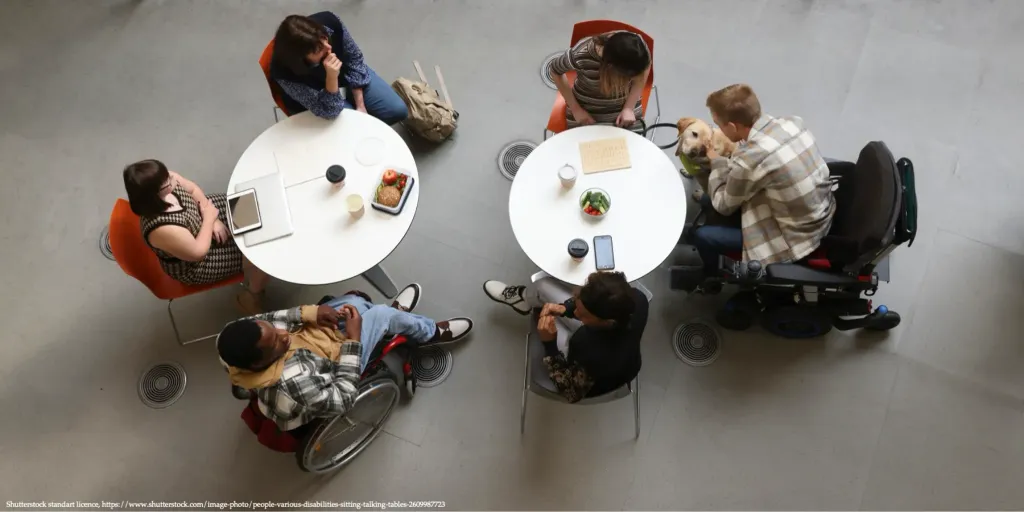
A significant proportion of the economics literature on the consequences of disability focuses on its implications for labor market activity and the effects of programs dedicated to supporting the disabled. This focus leaves out fundamental aspects of disability, and poor health more generally, which play a crucial role in directly determining individual and social welfare. In this policy brief, we report key results from a recent paper in which we examine the implications of disability from the perspective of time use (Hamermesh and Myck, 2025). Our analysis is based on the data from the American and the Polish Time Use Surveys and is complemented with time use information from several other countries. We examine how disability affects the variety of activities performed during the day by older individuals and how it changes the amount of time spent on the main, most common activities. Using information on how people value variety, we provide monetary estimates of the time cost of disability.
An illustration on notes of caution of Altonji et al. (2005)

Treatment exogeneity in non-experimental settings: an illustration on notes of caution of Altonji et al. (2005)
Using data from the Survey of Health, Ageing and Retirement in Europe (SHARE) the author applies the Altonji, Elder and Taber (2005) method to examine the relationship between unemployment and later life well-being outcomes in Poland. Results illustrate that the notes of caution of the authors of the approach, which has become a very popular toolkit to support the assumption of treatment exogeneity in non-experimental settings, should be taken seriously to avoid the risk of misusing this very powerful design.
The complete article can be found here:
Myck, M. (2026) “Treatment exogeneity in non-experimental settings: an illustration on notes of caution of Altonji et al. (2005)”, Economics Letters, vol. 264, 112979; https://doi.org/10.1016/j.econlet.2026.112979
The article can be downloaded for free until July 05 2026 under this link:
https://authors.elsevier.com/a/1mxfubZeeA5P6
Make yourself a Christmas tree!
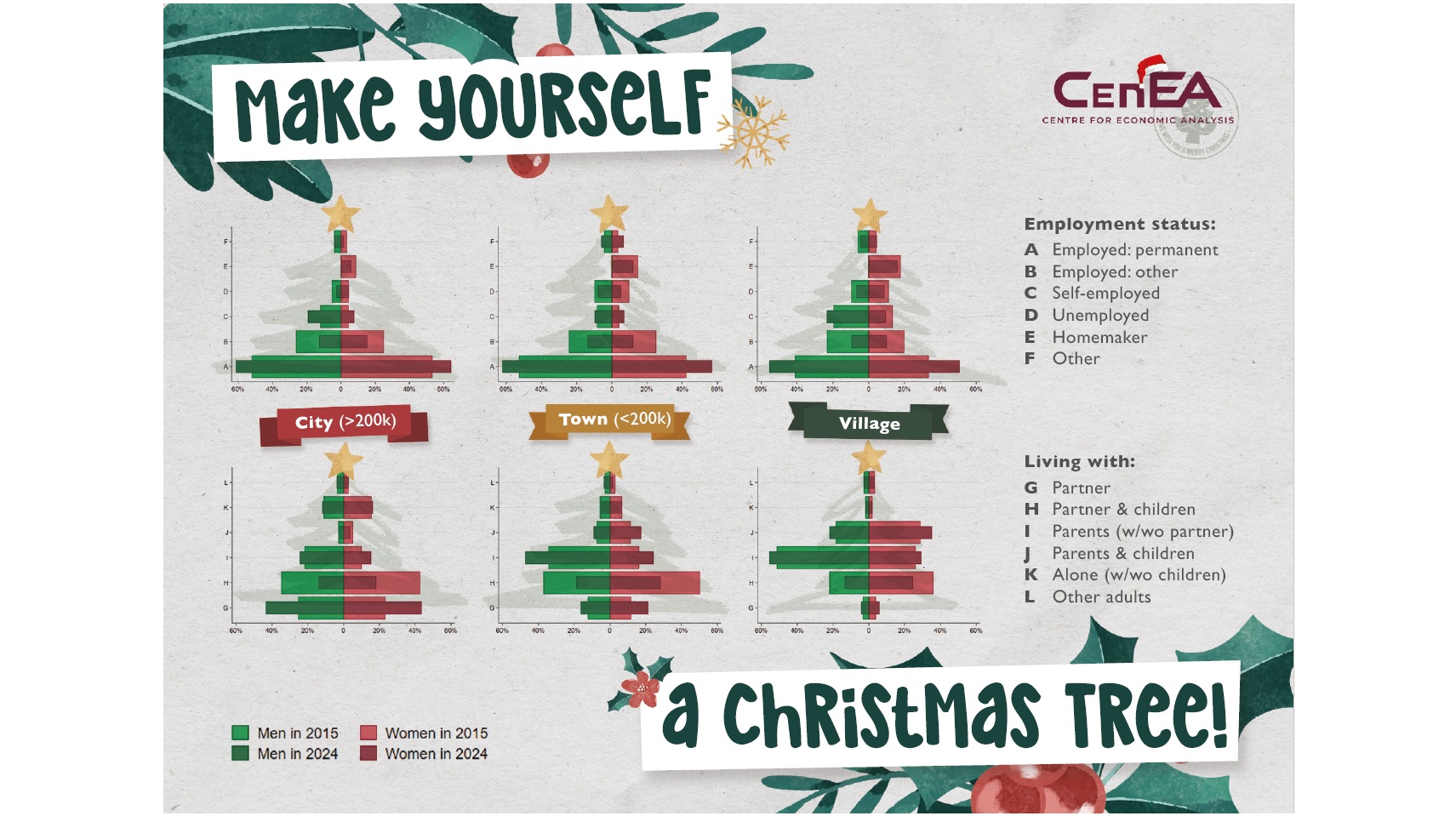
In our forthcoming report on young adults in Poland we explore long-term trends in material conditions, co-residence, and family choices. Our data-driven Christmas trees are created using
information on individuals aged 26-35 from the Polish Household Budget Surveys.
Feel free to download the underlying statistics and code: you can make the trees on your own and adapt the code for other purposes!
With best wishes for Christmas and the New Year from our team at CenEA!
We continue to support our colleagues and partners from the Kyiv School of Economics in the challenging times of the ongoing Russian aggression. Please visit the website of the KSE Foundation
to support their humanitarian and educational initiatives.
Thank you for your solidarity!
#AcademicsStandWithUkraine
Finansowe wsparcie gospodarstw domowych 2025: do kogo trafia „socjal”?
W niniejszym Komentarzu przedstawiono koszty i dystrybucyjny rozkład czterech powszechnych elementów wsparcia i porównano je do świadczeń warunkowanych sytuacją materialną gospodarstw domowych. W kontekście dalszego rozszerzania zakresu wsparcia w formie nowych świadczeń i usług (renta wdowia, świadczenie wspierające, asystencja osobista) przedstawiono przykładowe możliwości ograniczenia ogólnych wydatków w powszechnym systemie wsparcia, ich rozkład dystrybucyjny i potencjalne oszczędności dla budżetu państwa.
Komentarz Przedwyborczy CenEA 25/11/2025: Finansowe wsparcie gospodarstw domowych 2025: do kogo trafia „socjal” ?
How the Combination of Income and the Quality of Local Conditions Affects Well-being in Old Age

Contemporaneous income and the quality of local living conditions have both received recognition in the literature as important determinants of subjective well-being. However, little is known about their joint impact and the possible moderating influence each may have on the relationship with the well-being of the other. In a recent study (Myck et al. 2025), we investigated the role of income and quality of local area on different dimensions of well-being of older adults in Poland. Our findings show that a higher quality of local conditions amplifies the association between income and well-being, which implies that high-income older individuals tend to benefit more from improved local conditions. Our findings suggest that low incomes may constrain older people from taking advantage of local public services, and thus draw attention to policies aimed at improving access to these services, especially in low-income, peripheral areas. While the results also point towards broad benefits of targeted income transfers, it is notable that their effective translation into higher well-being strongly varies with the quality of municipal local conditions.
Towards European Union Membership: Poland’s EU Pre-accession Funds and Infrastructure Development

In advance of formal membership, candidate countries are offered three pillars of EU assistance: trade concessions, stabilization and association agreements and financial support. These instruments aim both to prepare candidates economically, politically and administratively, and to signal accession’s benefits to their populations. In this paper we describe the channels in which the third pillar – the EU pre-accession funds – affected Poland’s economic and institutional development ahead of its 2004 membership. The funds were designed to accelerate institutional transformation, modernize agriculture, strengthen rural communities, improve transport networks, and promote environmental protection. In Poland, between the mid-1990s and 2003, they supported extensive investments that produced unprecedented improvements in technical infrastructure. Poland’s accession referendum in 2003 turned decisively in favor of EU membership, despite strong regional variation in support. While no causal evidence is available, we argue that without the EU-funded infrastructural transformation, its outcome would have been less certain. For current EU candidate countries, Poland serves as an excellent example of how targeted external financial assistance can support structural transformation ahead of integration with the EU.
Other publications

Below you can find links to selected other publications by CenEA researchers:
2025
Myck, M., 2025. Treatment Exogeneity in Non-Experimental Settings: An Illustration on Notes of Caution of Altonji et al. (2005).
2024
Chrostek, P., Karbownik, K., Myck, M., 2024. Labor Market Externalities of Pre-Retirement Employment Protection.
2023
Karamba, W., Myck, M., Trzcinski, K., Tong, K., 2023. Fiscal Policy Effects on Poverty and Inequality in Cambodia, Policy Research Working Papers. The World Bank.
2022
Myck, M., Trzciński, K. 2022. Income Tax Policy in Europe Between Two Crises: From the Great Recession to the COVID-19 Pandemic. CenEA Working Paper Series WP 05/22.
2021
CASE, Tyrowicz, J., Myck, M., Wojciechowski, P., 2021. The Polish Deal: The Economic Consequences of the Proposed New Tax System / Polski Ład: Gospodarcze skutki proponowanych zmian w systemie podatkowym.
Myck, M., Oczkowska, M., Wowczko, I. 2021. Gender preferences in Central and Eastern Europe as reflected in partnership and fertility outcomes. CenEA Working Paper Series WP 01/21.
Myck, M., Król, A., Oczkowska, M., Trzciński, K. 2021. The childcare benefit after five years: 500 plus how much? CenEA Commentary.
2020
Myck, M., Oczkowska, M., Trzciński, K. 2020. Household exposure to financial risks: the first wave of impact from COVID-19 on the economy. CenEA Commentary Papers.
Nicińska, A., Kalbarczyk, M., Fihel, A., 2020. Financial and non-financial private transfers from close ones: beyond family and kinship. CenEA Working Paper Series WP 01/20.
Walsh, K., Vidovićová, L., Dahlberg, L., Conboy, P., Tiilikainen, E., Sepannen, M., Ogg, J., Myck, M., Aartsen, M., Burholt, V., Lamura, G., Draulans, V., Vidovićová, L., Tournier, I., Petrová Kafková, M., Torres, S., Lowenstein, A., Waldegrave, C., Barbabella, F., Scharf, T., Emirhafizovic, M., Villar, F., Motel-Klingebiel, A., 2020. Multidimensional Social Exclusion in Later life : Briefing Paper and a Roadmap for Future Collaborations in Research and Policy. ROSEnet.
2019
Magda, I., Brzeziński, M., Chłoń-Domińczak, A., Kotowska, I.E., Myck, M., Najsztub, M., Tyrowicz, J., 2019. „Rodzina 500+” – ocena programu i propozycje zmian. IBS – Inst. Badań Strukt.
Myck, M., Brzezinski, M., Najsztub, M. 2019. Reevaluating distributional consequences of the transition to market economy in Poland: new results from combined household survey and tax return data. CenEA Working Paper Series WP 04/19.
Myck, M., Freier, R., Najsztub, M. 2019. Lights along the frontier: convergence of economic activity in the proximity of the Polish-German border, 1992-2012. CenEA Working Paper Series WP03/19.
Myck, M., Najsztub, M. 2019. Policy in the Pipeline: Identifying Regional Public Investment Priorities Using a Natural Experiment. CenEA Working Paper Series WP02/19.
Myck, M., Najsztub, M. 2019. Implications of the Polish 1999 administrative reform for regional socio-economic development. CenEA Working Paper Series WP01/19.
Myck, M., Trzciński, K., 2019. From Partial to Full Universality: The Family 500+ Programme in Poland and its Labor Supply Implications. Ifo DICE Report 17, 36–44.
2018
Trzciński, K, 2018. „Border Bridges on the Oder-Neisse Line”, CenEA Research Note 1/2018, CenEA.
2017
Aldaz-Carroll, E., Varela, G.J., Myck, M., Inchauste Comboni, M.G., Van Den Brink, R.J.E., Skrok, E., Thomas, T.D., Schiffbauer, M.T., 2017. Lessons from Poland: A Sustainable and Inclusive Transition to High Income.
Gomulka, S., Neneman, J., Myck, M., 2017. More for Less: What Tax System for Poland? (Więcej za mniej: jaki system podatkowy dla Polski). CASE Research Paper No. 150/2017
Myck, M., Bohacek, R. 2017. Economic Consequences of Political Persecution. CenEA Working Paper Series WP02/17.
Myck, M., Oczkowska, M. 2017. Shocked by therapy? Unemployment in the first years of the socio-economic transition in Poland and its long-term consequences. CenEA Working Paper Series WP01/17
Myck, M., Ogg, J., Aigner-Walder, B., Kåreholt, I., Kostakis, I., Motel-Klingebiel, A., Marbán-Flores, R., Murdock, E., Perek-Bialas, J., Thelin, A., 2017. Economic Aspects of Old Age Exclusion: A Scoping Report.
2016
Myck, M., 2016. Estimating Labour Supply Response to the Introduction of the Family 500+ Programme. CenEA Working Paper Series WP01/16.
Myck, M., Najsztub, M. 2016. Distributional consequences of tax and benefit policies in Poland: 2005-2014. CenEA Working Paper Series WP02/16.
2015
Bukowski, P. 2015. How History Matters for Student Performance. Lessons from the Partitions of Poland. CenEA Working Paper Series WP03/15.
Kurowska, A., Myck, M., Wrohlich, K. 2015. Making work pay: increasing labour supply of secondary earners in low income families with children in Poland. CenEA Working Paper Series WP02/15.
Myck, M., Lachowska, M. 2015. The Effect of Public Pension Wealth on Saving and Expenditure. CenEA Working Paper Series WP01/15.
Myck, M., Oczkowska, M., Duda, D., Malter, F., Börsch-Supan, A., 2015. Innovations for better understanding deprivation and social exclusion. SHARE Wave 5, 29–36.
2014
Abramowska-Kmon, A., Bała, M., Topór-Mądry, R., Rynko, M., Palczyńska, M., Paczyński, W., Oczkowska, M., Najsztub, M., Michałejko, M., Kotowska, I.E., Chłoń-Domińczak, A., Maliszewska, A., Holzer-Żelażewska, D., Myck, M., Nicińska, A., Kalbarczyk-Stęclik, M. (Eds.), 2014. Portret generacji 50+ w Polsce i w Europie: wyniki badania zdrowia, starzenia się i przechodzenia na emeryturę w Europie (SHARE). Instytut Badań Edukacyjnych, Warszawa.
Myck, M., Najsztub, M. 2014. Data and model cross-validation to improve accuracy of microsimulation results: estimates for the Polish Household Budget Survey. CenEA Microsimulation Report MR01/14.
Myck, M. 2014. Stability of elasticity estimates in the context of significant changes in labour market incentives. CenEA Working Paper Series WP01/14.
2013
Adena, M., Myck, M. 2013. Poverty and transitions in health. CenEA Working Paper Series WP03/13.
Myck M., Domitrz, A., Morawski, L., Semeniuk, A. 2013. Financial incentives to work in the context of a complex reform package and growing wages: the Polish experience 2005-2011. CenEA Working Paper Series WP01/13.
Geyer, J. 2011. The effect of health and employment risks on precautionary savings. CenEA Working Paper Series WP01/11.
Karbownik, K., Myck, M. 2011. Mommies’ girls get dresses, daddies’ boys get toys. Gender preferences in Poland and their implications. CenEA Working Paper Series WP03/11.
Magda, I., Lewandowski, P., Lis, M., Bukowski, M., Oczkowska, M., Myck, M., Kundera, M., Bucholtz, S., 2013. Employment in Poland 2011 – Poverty and jobs. Center for Human Resources Development.
2012
Karbownik, K., Myck, M. 2012. For some mothers more than others: how children matter for labour market outcomes when both fertility and female employment are low. CenEA Working Paper Series WP04/12.
Karbownik, K. 2012. The determinants of teacher mobility in Sweden. CenEA Working Paper Series WP02/12.
Karbownik, K. 2012. Job mobility among high skilled and low skilled teachers in Sweden. CenEA Working Paper Series WP01/12.
Kurowska, A., Myck, M., Wrohlich, K. 2012. Family and labor market choices – requirements to guide effective evidence-based policy. CenEA Working Paper Series WP03/12.
2011
Myck, M., Bohacek, R. 2011. Long shadows of history – persecution in Central Europe and its labor market consequences. CenEA Working Paper Series WP02/11.
2010
Bohacek, R., Myck, M. 2010. Persecution in Central Europe and its consequences on the lives of SHARE respondents. CenEA Working Paper Series WP02/10.
Geyer, J., Myck, M. 2010. Poorer health – shorter hours? Health and flexibility of hours of work. CenEA Working Paper Series WP01/10.
Morawski, L., Myck, M. 2010. Distributional effects of the Polish Child Tax Credit and its potential reforms. CenEA Microsimulation Report MR01/10.
2009
Bargain, O., Morawski, L., Myck, M., Socha, M. 2009. As SIMPL as that: Introducing a Tax-Benefit Microsimulation model for Poland. CenEA Working Paper Series WP01/09.
Bond, S., Chennells, L., Dilnot, A., Emmerson, C., Frayne, C., Goodman, A., Mccrae, J., Myck, M., Paull, G., Rauh, J., Reed, H., Simpson, H., Smith, Z., Tanner, S., John, J., Reenen, J., Walton, D., Crevel-Robinson, C., 2009. The IFS Green Budget January 2000.
Czapiński, J. 2009. Psychological and social well-being of Poles aged 50+ compared to selected European societies. CenEA Research Note Series RN01en/09.
Haan, P., Myck, M. 2009. Safety net still in transition: labour market incentive effects of extending social support in Poland. CenEA Working Paper Series WP02/09.
Haan, P., Myck, M. 2009. Dynamics of poor health and non-employment. CenEA Working Paper Series WP07/09.
Haan, P., Myck, M. 2009. Multi-family households in a labour supply model: a calibration method with application to Poland. CenEA Working Paper Series WP04/09.
Kalbarczyk, M., Nicińska, A. 2009. Altruism in the modern family: private transfers between parents and their biological and non-biological children. CenEA Working Paper Series WP09/09.
Levy, H., Morawski, L., Myck, M. 2009. Alternative tax-benefit strategies to support children in Poland. CenEA Working Paper Series WP03/09.
Myck, M., Czapiński, J., Dorabialski, W., Gilis-Januszewska, A., Kalbarczyk, M., Kula, G., Nicińska, A., Topór-Mądry, R., Wiśniewski, M. 2009. Health, work and life-style of the 50+ population in Poland in comparison with other European countries. CenEA Research Note Series RN02en/09.
Myck, M., Nicińska, A., Morawski, L. 2009. Count your hours: returns to education in Poland. CenEA Working Paper Series WP08/09.
Myck, M., Ochmann, R., Qari, S. 2009. Dynamics of Earnings and Hourly Wages in Germany. CenEA Working Paper Series WP06/09.
Myck, M. 2009. Physical activity patterns of European 50+ populations. CenEA Research Note Series RN03en/09.
2008
Myck, M., Ochmann, R.R., Qari, S., 2008. Dynamics of Earnings and Hourly Wages in Germany. IZA DP No. 3751.
2007
Bargain, O., Morawski, L., Myck, M., Socha, M.W., 2007. As SIMPL as that: introducing a tax-benefit microsimulation model for Poland (Working Paper No. 2988). IZA Discussion Papers.
Brewer, M., Goodman, A., Myck, M., Shaw, J., Shephard, A., 2007. Poverty and Inequality in Britain: 2004. Technical Report Comment. C096 Institute for Fiscal Studies London
Myck, M., 2007. Wages and Ageing: Is There Evidence for the “Inverse-U” Profile? IZA Discuss. Pap., IZA Discussion Papers.
2006
Myck, M., Reed, H., 2006. A review of static and dynamic models of labour supply and labour market transitions (Working Paper No. 06/15). IFS Working Papers.
2005
Myck, M., Reed, H., 2005. Disabled people in a dynamic model of labour supply and labour market transitions. Corporate Document Services.
2004
Myck, M., Paull, G., 2004. The role of employment experience in explaining the gender wage gap (Working Paper No. 04/16). IFS Working Papers.
2003
Goodman, A., Myck, M., Shephard, A., 2003. Sharing in the nation’s prosperity? Pensioner poverty in Britain (Report No. C093), (IFS Commentaries C093 ). Institute for Fiscal Studies: London, UK. Institute for Fiscal Studies, London, UK.
2001
Brewer, M., Clark, T., Myck, M., 2001a. Credit where it’s due? An assessment of the new tax credits (Report No. C086), (IFS Commentaries C086 ). Institute for Fiscal Studies: London, UK. Institute for Fiscal Studies, London, UK.
Brewer, M., Myck, M., Reed, H., 2001b. Financial support for families with children: options for the new integrated child credit (Report No. C082), (IFS Commentaries C082 ). Institute for Fiscal Studies: London, UK. Institute for Fiscal Studies, London, UK.
Clark, T., Myck, M., Smith, Z., 2001. Fiscal reform affecting households, 1997–2001. IFS Election Briefing Note No. 5 May 2001.
2000
Myck, M., 2000. Fiscal reforms since May 1997. IFS Briefing Notes.
Policy briefs
Below you can find links to selected policy briefs and policy papers by CenEA researchers:
2026
Myck, M., Hamermesh D.S., M., 2026. Consequences-of-disability-from-the-perspective-of-time-allocation.pdf . FREE Policy Brief Series.
2025
Myck, M., Oczkowska, M., Kulati E., 2025. How the Combination of Income and the Quality of Local Conditions Affects Well-being in Old Age. FREE Policy Brief Series.
Myck, M., Oczkowska, M., 2025, Towards European Union Membership: Poland’s EU Pre-accession Funds and Infrastructure Development. FREE Policy Brief Series.
Myck, M. 2025. The Polish Presidential Elections 2025: Can the Democratic Coalition Complete Their 2023 Victory? FREE Policy Brief Series.
Myck, M., Król, A., Oczkowska, M. 2025. Three Years On – Ukrainians in Poland after Russia’s 2022 Invasion. FREE Policy Brief Series.
2024
Campa, P., Myck, M., Oczkowska, M. Perrotta Berlin, M., Roine, J. 2024. Closing the Gender Data Gap. FROGEE Policy Brief Series.
Myck, M. 2024. Christmas Time in Poland Through the Lens of Gender Equality. FREE Policy Brief Series.
Myck, M., Król, A., Oczkowska, M. 2024. Widowhood in Poland: Reforming the Financial Support System. FREE Policy Brief Series.
Myck, M., Król, A., Oczkowska, M. 2024. Reforming Financial Support in Widowhood: The Current System in Poland and Potential Reforms. FREE Policy Paper Series.
Oczkowska, M., Myck, M. 2024. “Active parent”: Addressing Labor Market Disadvantages of Mothers in Poland. FREE Policy Brief Series.
Oczkowska, M. 2024. Gender Gap in Life Expectancy in Poland. FROGEE Policy Brief Series.
2023
Kulati, E. 2023. Lessons From the FROGEE Conference “The Playing Field in Academia: Why Are Women Still Underrepresented?”. FREE Policy Brief Series.
Myck, M., Król, A., Oczkowska, M., Trzciński, K. 2023. Polish Parliamentary Elections 2023: Social Transfers and the Voters the Government is Counting On Policy Brief. FREE Policy Brief Series.
Myck, M., Oczkowska, M., Garten, C., Krol, A., Brandt, M. 2023. What Can We Learn from Regional Patterns of Mortality During the Covid-19 Pandemic? FREE Policy Brief Series.
Perrotta Berlin, M., Campa, P. Anisimova, H., Myck, M., Oczkowska, M., Shapoval, N., Markuts, Y. Bosnic, M. 2023. Rebuilding Ukraine: The Gender Dimension of the Reconstruction Process. FROGEE Policy Brief Series.
2022
Garten, C., Myck, M., Oczkowska, M. 2022. Homeownership and Material Security in Later Life. FREE Policy Brief Series.
Myck, M., Oczkowska, M., Perrotta Berlin, M., Roine, J., Trzciński, K. 2022. Understanding the Economic and Social Context of Gender-based and Domestic Violence in Central and Eastern Europe – Preliminary Survey Evidence. FREE Policy Brief Series.
Trzciński, K., Król, A., 2022. Social norms, conspiracy theories and vaccine scepticism: a snapshot from the first year of the COVID-19 pandemic in Poland. FREE Policy Brief Series.
2021
Myck, M., Król, A., Oczkowska, M. 2021. The double burden of paid and unpaid work on women in Poland. FROGEE Policy Brief Series.
Myck, M., Oczkowska, M., Trzciński, K. 2021. Why are there fewer women than men in politics? FROGEE Policy Brief Series.
Myck, M., Oczkowska, M., Trzciński, K., Król, A. 2021. Five Years in Operation: the Polish Universal Child Benefit. FREE Policy Brief Series.
2020
Myck, M., Brzezinski, M., Najsztub, M. 2020. Income Inequality in Transition. New Results for Poland Combining Survey and Tax Return Data. FREE Policy Brief Series.
Myck, M., Oczkowska, M. 2020. Inequalities between men and women in Poland 30 years after the transition. FROGEE Policy Brief Series.
Myck, M., Oczkowska, M., Brandt, M., Garten, C., Schmitz, A. 2020. Ahead of Future Waves of Covid-19: A Regional Perspective on Health Risks and Healthcare Resources in Germany and Poland. FREE Policy Paper Series.
Myck M., Oczkowska M., Trzciński, K. 2020. Safety of older people during the Covid-19 pandemic: Co-residence of people aged 65+ in Poland compared to other European countries. FREE Policy Paper Series.
Myck M., Oczkowska M., Trzciński K. 2020. School lockdown: distance learning environment during the COVID-19 outbreak. FREE Policy Paper Series.
Myck M., Oczkowska M., Trzciński K. 2020. Household Exposure to Financial Risks: The First Wave of Impact From COVID-19 on the Economy. FREE Policy Paper Series.
2019
Myck, M., Oczkowska, M., Wowczko, I. 2019. Family policies in Poland – addressing one of the lowest fertility rates in Europe. FREE Policy Brief Series.
Myck, M., Trzciński, K. 2019. From Partial to Full Universality: The Family 500+ Programme in Poland and Its Labour Supply Implications. FREE Policy Brief Series.
2018
Myck, M., Oczkowska, M. 2018. Unemployment in Transition and Its Long-term Consequences. FREE Policy Brief Series.
2017
Morawski, L., Myck, M., Oczkowska, M. 2017. Paid Work after Retirement – Does Quality of Your Main Job in the Past Matter? FREE Policy Brief Series.
Myck, M., Najsztub, M. 2017. Socio-Economic Policy in Poland: A Year of Major Changes in Benefits, Taxes, and Pensions. FREE Policy Brief Series.
2016
Coupe, T., Myck, M., Najsztub, M. 2016. And the Lights Went Out – Measuring the Economic Situation in Eastern Ukraine. FREE Policy Brief Series.
2015
Myck, M., Oczkowska, M. 2015. Distribution of the VAT burden in Poland by income group and demographic characteristics. FREE Policy Brief Series.
Myck, M., Oczkowska, M. 2015. Examining Social Exclusion among the 50+ in Europe – Evidence from the Fifth Wave of the SHARE Survey. FREE Policy Brief Series.
Myck, M., Oczkowska, M. 2015. Taxes and Benefits in the Polish Parliamentary Election Campaigns. FREE Policy Brief Series.
2014
Myck, M., Kurowska, A., Kundera, M. 2014. Financial Support for Families with Children and Its Trade-Offs: Balancing Redistribution and Parental Work Incentives. FREE Policy Brief Series.
2013
Adena, M., Myck, M. 2013. Old-Age Poverty and Health – How Much Does Income Matter? FREE Policy Brief Series.
Myck, M., Oczkowska, M. 2013. Increasing Resources for Families with Children Through the Tax System: Recent Reform Proposals from Poland. FREE Policy Brief Series.
2011
Myck, M. 2011. Polish Pre-Election Polls Seem Unmoved by Electoral Giveaways. FREE Policy Brief Series.
Myck, M. 2011. Incomes of Polish Households in the Context of 2005-2011 Tax and Benefit Reforms: A Pre-Election Analysis. FREE Policy Brief Series.
Selected journal articles
Below you can find links to selected journal articles by CenEA researchers:
Adena, M., Hamermesh, D., Myck, M., Oczkowska, M., 2023. Home Alone: Widows’ Well-Being and Time. Journal of Happiness Studies 24, 813–838.
Adena, M., Myck, M., 2014. Poverty and transitions in health in later life. Social Science & Medicine 116, 202–210.
Adena, M., Myck, M., 2013. Poverty and transitions in key areas of quality of life, in: Börsch-Supan, A., Brandt, M., Litwin, H., Weber, G. (Eds.), Active Ageing and Solidarity between Generations in Europe: First Results from SHARE after the Economic Crisis. De Gruyter, pp. 55–74.
Bargain, O., Beblo, M., Beninger, D., Blundell, R., Carrasco, R., Chiuri, M.-C., Laisney, F., Lechene, V., Moreau, N., Myck, M., Ruiz-Castillo, J., Vermeulen, F., 2006. Does the Representation of Household Behavior Matter for Welfare Analysis of Tax-benefit Policies? An Introduction. Review of Economics of the Household 4, 99–111.
Beninger, D., Bargain, O., Beblo, M., Blundell, R., Carrasco, R., Chiuri, M.-C., Laisney, F., Lechene, V., Longobardi, E., Moreau, N., Myck, M., Ruiz-Castillo, J., Vermeulen, F., 2006. Evaluating the Move to a Linear Tax System in Germany and Other European Countries. Review of Economics of the Household 4, 159–180.
Berlin, M.P., Campa, P., Myck, M., Oczkowska, M., Roine, J., 2024. Economic and social consequences of gender attitudes in Eastern Europe – evidence from survey data. Baltic Journal of Economics 24, 282–285.
Bohacek, Radim, Myck, M., 2011. Persecution in Central Europe and Its Consequences on the Lives of SHARE Respondents, in: Börsch-Supan, A., Brandt, M., Hank, K., Schröder, M. (Eds.), The Individual and the Welfare State. Springer Berlin Heidelberg, Berlin, Heidelberg, pp. 271–285.
Börsch-Supan, A., Kneip, T., Litwin, H., Myck, M., Weber, G. (Eds.), 2015. Material deprivation items in SHARE Wave 5 data: a contribution to a better understanding of differences in material conditions in later life, in: Ageing in Europe – Supporting Policies for an Inclusive Society. De Gruyter, pp. 25–38.
Brzezinski, M., Myck, M., Najsztub, M., 2022. Sharing the gains of transition: Evaluating changes in income inequality and redistribution in Poland using combined survey and tax return data. European Journal of Political Economy 73, 102121.
Clark, T., Dilnot, A., Goodman, A., Myck, M., 2002. Taxes and Transfers 1997–2001. Oxford Review of Economic Policy 18, 187–201.
Dearden, L., McIntosh, S., Myck, M., Vignoles, A., 2002. The Returns to Academic and Vocational Qualifications in Britainv. Bulletin of Economic Research 54, 249–274.
Domitrz, A., Morawski, L., Myck, M., Semeniuk, A., 2013. Dystrybutywny wpływ reform podatkowo–świadczeniowych z lat 2006− 2011. Bank i Kredyt 44, 261–286.
Freier, R., Myck, M., Najsztub, M., 2021. Lights along the frontier: convergence of economic activity in the proximity of the Polish-German border, 1992–2012. Applied Economics 53, 4245–4262.
Garten, C., Myck, M., 2024. Homeownership and portfolio choice in later life. Applied Economics Letters 1–5.
Garten, C., Myck, M., Oczkowska, M., 2022. Homeownership and the Perception of Material Security in Old Age. Applied Economics 1–13.
Haan, P., and Myck, M., 2012. Multi-family households in a labour supply model: a calibration method with application to Poland. Applied Economics 44, 2907–2919.
Haan, P., Morawski, L., Myck, M., 2008. Taxes, Benefits and Financial Incentives to Work: The United Kingdom, Germany and Poland Compared. Bank i Kredyt 1, 5-33.
Haan, P., Myck, M., 2010. „Safety net still in transition: labour market incentive effects of social support in Poland and Germany “. Bank i Kredyt 41, 5–34.
Haan, P., Myck, M., 2009. Dynamics of health and labor market risks. Journal of Health Economics 28, 1116–1125.
Haan, P., Myck, M., 2007. Apply with Caution: Introducing UK-Style In-Work Support in Germany. Fiscal Studies 28, 43–72.
Hamermesh, D.S., Myck, M., Oczkowska, M., 2023. Widows’ Time: Adjusting to Loss, in: Research in Labor Economics 50th Celebratory Volume. Emerald Publishing Limited, pp. 369–396.
Karbownik, K., Myck, M., 2017. Who gets to look nice and who gets to play? Effects of child gender on household expenditures. Review of Economics of the Household 15, 925–944.
Karbownik, K., Myck, M., 2016. For Some Mothers More than Others: How Children Matter for Labour Market Outcomes When Both Fertility and Female Employment are Low. Economics of Transition 24, 705–725.
Kulati, E., Myck, M., Pasini, G., 2023. Temporal discounting in later life. Journal of Economic Behavior & Organization 213, 87–101.
Kurowska, A., Myck, M., Wrohlich, 2017. Making work pay: increasing labour supply of secondary earners in low income families with children. Contemporary Economics 11, 161–170.
Lachowska, M., Myck, M., 2018. The Effect of Public Pension Wealth on Saving and Expenditure. American Economic Journal: Economic Policy 10, 284–308.
Lachowska, M., Myck, M., 2015. What is the Relation between Public Pensions and Private Savings? Employment Research 22, 1–3.
Morawski, L., Bargan, O., Myck, M., Socha, M.W., 2008. Mikrosymulacyjny model podatkowo-świadczeniowy (SIMPL03). Wiadomości Statystyczne. The Polish Statistician. 30–38.
Morawski, L., Myck, M., 2011. Distributional Effects of the Child Tax Credit in Poland and Its Potential Reforms. Ekonomista 815–830.
Morawski, L., Myck, M., 2010. ‘Klin’-ing up: Effects of Polish tax reforms on those in and on those out. Labour Economics. 17, 556–566.
Myck, M., 2020. The Analysis of Polish Benefits System with the Application of Microsimulation Model SIMPL. Social Policy Issues. 11, 87–107.
Myck, M., 2015. Living longer, working longer: the need for a comprehensive approach to labour market reform in response to demographic changes. European Journal of Ageing 12, 3–5.
Myck, M., 2011. Wyzwania dla polityki spoleczno-gospodarczej w Niemczech i w Polsce na podstawie danych SHARE 24. Ekonomia. Rynek, Gospodarka, Społeczeństwo 24–38.
Myck, M., 2010. Wages and Ageing: Is There Evidence for the ‘Inverse-U’ Profile? Oxford Bulletin of Economics and Statistics 72, 282–306.
Myck, M., 2010. Physical activity patterns of European 50+ populations. Advances in Rehabilitation 3.
Myck, M., 2008. Analizy polskiego systemu podatkowo-zasiłkowego z wykorzystanie modelu mikrosymulacyjnego SIMPL. Problemy Polityki Społecznej 87–107.
Myck, M., 2002. How the New Deal works. Economic Review 19.
Myck, M., Bargain, O., Beblo, M., Beninger, D., Blundell, R., Carrasco, R., Chiuri, M.-C., Laisney, F., Lechene, V., Longobardi, E., Moreau, N., Ruiz-Castillo, J., Vermeulen, F., 2006. The Working Families’ Tax Credit and Some European Tax Reforms in A Collective Setting. Review of Economics of the Household 4, 129–158.
Myck, M., Domitrz, A., Morawski, L., Semeniuk, A., 2015. Financial incentives to work in the context of a complex reform package and growing wages: the Polish experience 2005–2011. Baltic Journal of Economics 15, 99–121.
Myck, M., Kurowska, A., Kundera, M., 2014. Financial support for families with children and its trade-offs: balancing redistribution and parental work incentives: Baltic Journal of Economics 13 (2), 61–85.
Myck, M., Morawski, L., Mycielski, J., 2007. Employment fluctuations and dynamics of the aggregate average wage in Poland, 1996–2003. Economics of Transition 15, 759–779.
Myck, M., Najsztub, M., 2020. Implications of the Polish 1999 administrative reform for regional socio‐economic development. Economics of Transition and Institutional Change 28, 559–579.
Myck, M., Najsztub M., 2015, Data and model cross-validation to improve accuracy of microsimulation results: Estimates for the polish household budget survey. International Journal of Microsimulation 8(1), 33-66.
Myck, M., Najsztub, M., Oczkowska, M., 2020. Implications of Social and Material Deprivation for Changes in Health of Older People. Journal of Aging and Health 32, 371–383.
Myck, M., Najsztub, M., Oczkowska, M., 2019. Is the socioeconomic gradient in later life health getting flatter? (La santé des personnes âgées selon le niveau socio-économique : évolutions au fil des générations ?) Retraite et société 81, 17–39.
Myck, M., Ochmann, R., Qari, S., 2011. Dynamics in transitory and permanent variation of wages in Germany. Economics Letters 113, 143–146.
Myck, M., Oczkowska, M., 2018. Shocked by therapy? Unemployment in the first years of the socio‐economic transition in Poland and its long‐term consequences. Economics of Transition 26, 695–724.
Myck, M., Oczkowska, M., 2022. Healthier over time? Period effects in health among older Europeans in a step-wise approach to identification. Social Science & Medicine 297, 114791.
Myck, M., Oczkowska, M., Garten, C., Król, A., Brandt, M., 2023. Deaths during the first year of the COVID-19 pandemic: insights from regional patterns in Germany and Poland. BMC Public Health 23, 177.
Myck, M., Oczkowska, M., Kulati, E., 2025. Income and well-being in old age: The role of local contextual factors. The Journal of the Economics of Ageing 30, 100551.
Myck, M., Oczkowska, M., Wowczko, I., 2024. Parental gender preferences in Central and Eastern Europe and differential early life disadvantages. Economics of Transition and Institutional Change 32, 237–263.
Myck, M., Reed, H., 2006. Tax and Benefit Reforms in a Model of Labour Market Transitions. Vierteljahrshefte zur Wirtschaftsforschung 75, 208–239.
Myck, M., Waldegrave, C., Dahlberg, L., 2021. Two dimensions of social exclusion: economic deprivation and dynamics of loneliness during later life in Europe. Social Exclusion in Later Life: Interdisciplinary and Policy Perspectives. 311–326.
Oczkowska, M., Trzcinski, K., Myck, M., 2024. Patterns of harassment and violence against women in Central and Eastern Europe: the role of the socio-economic context and gender norms in international comparisons. Baltic Journal of Economics 24, 261–281.
Ogg, J., Myck, M., 2021. Introduction: Framing Economic Exclusion, in: Walsh, K., Scharf, T., Van Regenmortel, S., Wanka, A. (Eds.), Social Exclusion in Later Life, International Perspectives on Aging. Springer International Publishing, 25–30.
Vermeulen, F., Bargain, O., Beblo, M., Beninger, D., Blundell, R., Carrasco, R., Chiuri, M.-C., Laisney, F., Lechene, V., Moreau, N., Myck, M., Ruiz-Castillo, J., 2006. Collective Models of Labor Supply with Nonconvex Budget Sets and Nonparticipation: A Calibration Approach. Review of Economics of the Household 4, 113–127.
Komentarze CenEA (PL)

Komentarze CenEA (PL) (CenEA Commentaries in Polish):
2025
Myck, M., Król, A., Podorska, P., Sitkowska B. 2025. Finansowe wsparcie gospodarstw domowych 2025: do kogo trafia „socjal”? Komentarz CenEA 25.11.2025.
Myck, M., Król, A., Oczkowska, M. 2025. Co obiecał Prezydent, co wprowadził rząd. Komentarz Przedwyborczy CenEA 07.04.2025.
Myck, M., Król, A., Oczkowska, M. 2025. Kampanijne deklaracje podatkowe Karola Nawrockiego. Komentarz Przedwyborczy CenEA 14.04.2025.
2024
Myck, M., Król, A., Oczkowska, M. 2024. Renta wdowia: konsekwencje proponowanych zmian w systemie wsparcia wdów i wdowców. Komentarz CenEA 27.02.2024.
Myck, M., Król, A., Oczkowska, M. 2024. Aktywnie w pracy, żłobku i w domu: finansowe konsekwencje programu „Aktywny rodzic”. Komentarz CenEA 05.08.2024.
Myck, M., Król, A., Oczkowska, M. 2024. Renta wdowia: zmiany w systemie wsparcia wdów i wdowców uchwalone przez Sejm RP. Komentarz CenEA 30.07.2024.
Myck, M., Król, A., Oczkowska, M. 2024. Zasiłek rodzinny: niezmiennie od 2016 roku. Komentarz CenEA 20.08.2024.
2023
Myck, M., Król, A., Oczkowska, M., Trzciński, K. 2023. Druga kadencja rządów Zjednoczonej Prawicy: Wsparcie rodzin w czasach wysokiej inflacji. Komentarz Przedwyborczy CenEA 13.09.2023.
Myck, M., Król, A., Oczkowska, M., Trzciński, K. 2023. Materiały metodyczne. Komentarz Przedwyborczy CenEA 13.09.2023.
Myck, M., Król, A., Oczkowska, M., Trzciński, K. 2023. Druga kadencja rządów Zjednoczonej Prawicy: Kto zyskał, a kto stracił? Komentarz przedwyborczy CenEA 14.09.2023.
Myck, M., Król, A., Oczkowska, M., Trzciński, K. 2023. Podatki i świadczenia w programach wyborczych 2023. Komentarz Przedwyborczy CenEA 09.10.2023.
Myck, M., Król, A., Oczkowska, M. 2023. Poszukując kompromisu: podatkowe deklaracje przedwyborcze i możliwości ich realizacji. Komentarz Wyborczy CenEA 30.10.2023.
Myck, M., Król, A., Oczkowska, M. 2023. Plany wydatkowe w exposé premiera Donalda Tuska wygłoszonym w Sejmie RP 12 grudnia 2023. Komentarz Wyborczy CenEA 18.12.2023.
2021
Myck, M., Oczkowska, M., Trzciński, K. 2021. Ekspertyza dotycząca redystrybucyjnych konsekwencji zmian regulacji podatkowych w ramach pakietu „Polski Ład” przyjętych przez Sejm dnia 1 października 2021 r. Kancelaria Senatu: Biuro analiz, dokumentacji i korespondencji. Opinie i ekspertyzy OE–371.
Myck, M., Oczkowska, M., Trzciński, K. 2021. „Polski Ład”: dystrybucyjne konsekwencje propozycji podatkowych Zjednoczonej Prawicy. Komentarze CenEA 19.05.2021.
Myck, M., Król, A., Oczkowska, M., Trzciński, K. 2021. Świadczenie wychowawcze po pięciu latach: 500 plus ile? Komentarz CenEA 31.03.2021.
2020
Myck, M., Oczkowska, M., Trzciński, K. 2020. Skala ryzyka finansowego dla gospodarstw domowych: pierwsza fala konsekwencji gospodarczych pandemii COVID-19. Komentarz CenEA 23.03.2020.
Myck, M., Oczkowska, M., Trzciński, K. 2020. Kwota wolna od podatku i świadczenie wychowawcze 500+ po pięciu latach od prezydenckich deklaracji. Komentarz Przedwyborczy CenEA 22.06.2020.
Myck, M., Oczkowska, M., Trzciński, K. 2020. Zamknięte szkoły: warunki uczniów do nauki zdalnej w okresie pandemii COVID-19. Komentarz CenEA 28.03.2020.
Myck, M., Oczkowska, M., Trzciński, K. 2020. Kwota wolna od podatku i zerowy PIT w końcówce prezydenckiej kampanii wyborczej 2020. Komentarz Przedwyborczy CenEA 07.07.2020.
2019
Myck, M., Najsztub, M., Oczkowska, M., Trzciński, K. 2019. Pakiet podatkowo-świadczeniowych rozwiązań rządu Zjednoczonej Prawicy. Raport Przedwyborczy CenEA 12.04.2019.
Myck, M., Oczkowska, M., Trzciński, K. 2019. Polityka podatkowo-świadczeniowa rządu Zjednoczonej Prawicy: program wyborczy i jego realizacja w latach 2015-2019. Raport Przedwyborczy CenEA 07.10.2019.
2017
Najsztub, M., Oczkowska, M., 2017. Relacje międzypokoleniowe w kontekście opieki sprawowanej nad wnukami przez dziadków na podstawie wyników badania „SHARE: 50+ w Europie”. Komentarz CenEA 24.01.2017.
2016
Myck, M., Kundera, M., Najsztub, M., Oczkowska, M. 2016. Zamrożony PIT i utrzymane wyższe stawki VAT – jak brak zmian w podatkach wpłynie na budżety gospodarstw domowych? Komentarz CenEA 18.01.2016.
Myck, M., Kundera, M., Najsztub, M., Oczkowska, M. 2016. 25 miliardów złotych dla rodzin z dziećmi: projekt Rodzina 500+ i możliwości modyfikacji systemu wsparcia. Komentarz CenEA 18.01.2016.
2015
Myck, M., Kundera, M., Najsztub, M., Oczkowska, M. 2015. VAT w wydatkach gospodarstw domowych: konsekwencje zmian systemu i zróżnicowanie obciążeń względem struktury demograficznej. I Raport Przedwyborczy CenEA 26.02.2015.
Myck, M., Kundera, M., Najsztub, M., Oczkowska, M. 2015. Przedwyborcze miliardy: jak je wydać i skąd je wziąć. II Raport Przedwyborczy CenEA 28.05.2015.
Myck, M., Kundera, M., Najsztub, M., Oczkowska, M. 2015. Przedwyborcze pięć miliardów: jak je wydać i skąd je wziąć. III Raport Przedwyborczy CenEA 28.05.2015.
Myck, M., Kundera, M., Najsztub, M., Oczkowska, M. 2015. Dwie kadencje w polityce podatkowo-świadczeniowej: programy wyborcze i ich realizacja w latach 2007-2015. IV Raport Przedwyborczy CenEA 03.09.2015.
Myck, M., Kundera, M., Najsztub, M., Oczkowska, M. 2015. Programy wyborcze 2015: kto zyska, kto straci i ile to będzie kosztowało. V Raport Przedwyborczy CenEA 13.10.2015.
Myck, M., Kundera, M., Najsztub, M., Oczkowska, M. 2015. Portfele gospodarstw domowych po exposé premier Beaty Szydło. Komentarze CenEA 19.11.2015.
Konsekwencje prezydenckiej propozycji podwyższenia kwoty wolnej od podatku. Informacja prasowa CenEA.
2014
Myck, M., Kundera, M., Najsztub, M., Oczkowska, M. 2014. Projekt budżetu na rok 2015 – jak plany odczują domowe budżety? Informacja prasowa 29.10.2014.
Myck, M., Kundera, M., Najsztub, M., Oczkowska, M. 2014. Zreformowana ulga by ulżyć rodzicom. Komentarz CenEA 19.09.2014.
Myck, M., Kundera, M., Najsztub, M., Oczkowska, M. 2014. Plany nowego rządu – „złotówka za złotówkę” zasadniczą zmianą w systemie wsparcia rodzin z dziećmi. Informacja prasowa CenEA 06.10.2014.
Myck, M., Kundera, M., Najsztub, M., Oczkowska, M. 2014. Pułapka bezrobocia i polski system świadczeń rodzinnych: modyfikacje systemu wspierające zatrudnienie rodziców. MR02/14.
Myck, M., Kundera, M., Najsztub, M., Oczkowska, M. 2014. Wsparcie dzieci bez względu na dochód: możliwości wprowadzenia powszechnego świadczenia rodzinnego w Polsce. Komentarz CenEA 26.03.2014.
2013
Myck, M., Kundera, M., Najsztub, M., Oczkowska, M. 2013. Ponowne „mrożenie” PIT w kontekście zmian podatkowych od 2009 roku. Komentarz CenEA 06.11.2013.
Myck, M., Kundera, M., Oczkowska, M. 2013. Finansowe wsparcie rodzin z dziećmi w Polsce w 2013 roku. Komentarze CenEA 27/05/2013.
Myck, M., Kundera, M., Oczkowska, M. 2013. Finansowe wsparcie rodzin w Polsce: przykłady modyfikacji w systemie podatkowym. MR02/13.
Myck, M., Kundera, M., Oczkowska, M. 2013. Prezydencka propozycja modyfikacji wsparcia rodzin w ramach systemu podatkowego. Komentarze CenEA 06/06/2013.
2012
Domitrz, A., Morawski, L., Myck, M., Semeniuk, A. 2012. Dystrybucyjny wpływ reform podatkowo-świadczeniowych wprowadzonych w latach 2006-2011. MR01/12.
Myck. M., Domitrz A., Kundera M., Oczkowska M., Semeniuk A. 2012. Konsekwencje waloryzacji systemu świadczeń rodzinnych 2012 w kontekście alternatywnych rozwiązań, Komentarze CenEA CO/002.
2011
Myck, M., Morawski, L., Domitrz, A., Semeniuk, A. 2011. Raport Przedwyborczy CenEA 2011 Część 1: 2006-2011: kto zyskał, a kto stracił? MR01/11.
Myck, M., Morawski, L., Domitrz, A., Semeniuk, A. 2011. Raport Przedwyborczy CenEA 2011 Część II: Wybory Parlamentarne 2011: kto zyska, a kto straci i ile to będzie kosztowało? MR02/11.